

Purchase Order Financing for Startups: How It Works and Who Qualifies
The order that could make your company is often the one you cannot afford to fill. A national retailer says yes, the volume is ten times anything you have shipped before, and your vendor wants paying before a single unit leaves the factory. For a young business, that is a wall.
Take Nadia, who launched a home-goods brand last year and just landed her first order from a national chain. The demand is real. Finding the cash to pay her vendor is the hard part. She is not alone in the squeeze. Sixty percent of small firms applied for financing in the prior year, many to pursue an expansion or new opportunity, yet only 42% of applicants received the full amount they sought and 22% received nothing. For a startup with a short track record, that gap is widest.
Purchase order financing is built for exactly this moment. This guide explains how it works, why it suits startups, who qualifies, and what it costs.
What Is Purchase Order Financing?
Purchase order financing is short-term funding tied to a single confirmed order. A financing company pays your vendor directly so the goods can be produced and shipped; once your customer pays, you settle with the financier and keep the balance.
It is transaction-based. You finance one confirmed order at a time, and each deal stands on its own order. For the full mechanics, see our guide to purchase order financing and how purchase order financing works.
By the numbers
Why startups feel the financing gap most
60%
of small firms applied
for financing last year
42%
got the full amount
they applied for
22%
of applicants received
no financing at all
15%+
gross margin most
financiers look for
Source: Federal Reserve Banks, 2026 Report on Employer Firms (2025 Small Business Credit Survey)
Why Purchase Order Financing Fits Startups
Most funding rewards history a startup does not have yet. Purchase order financing works differently, and that difference is why it fits.
Approval rides on your customer's strength
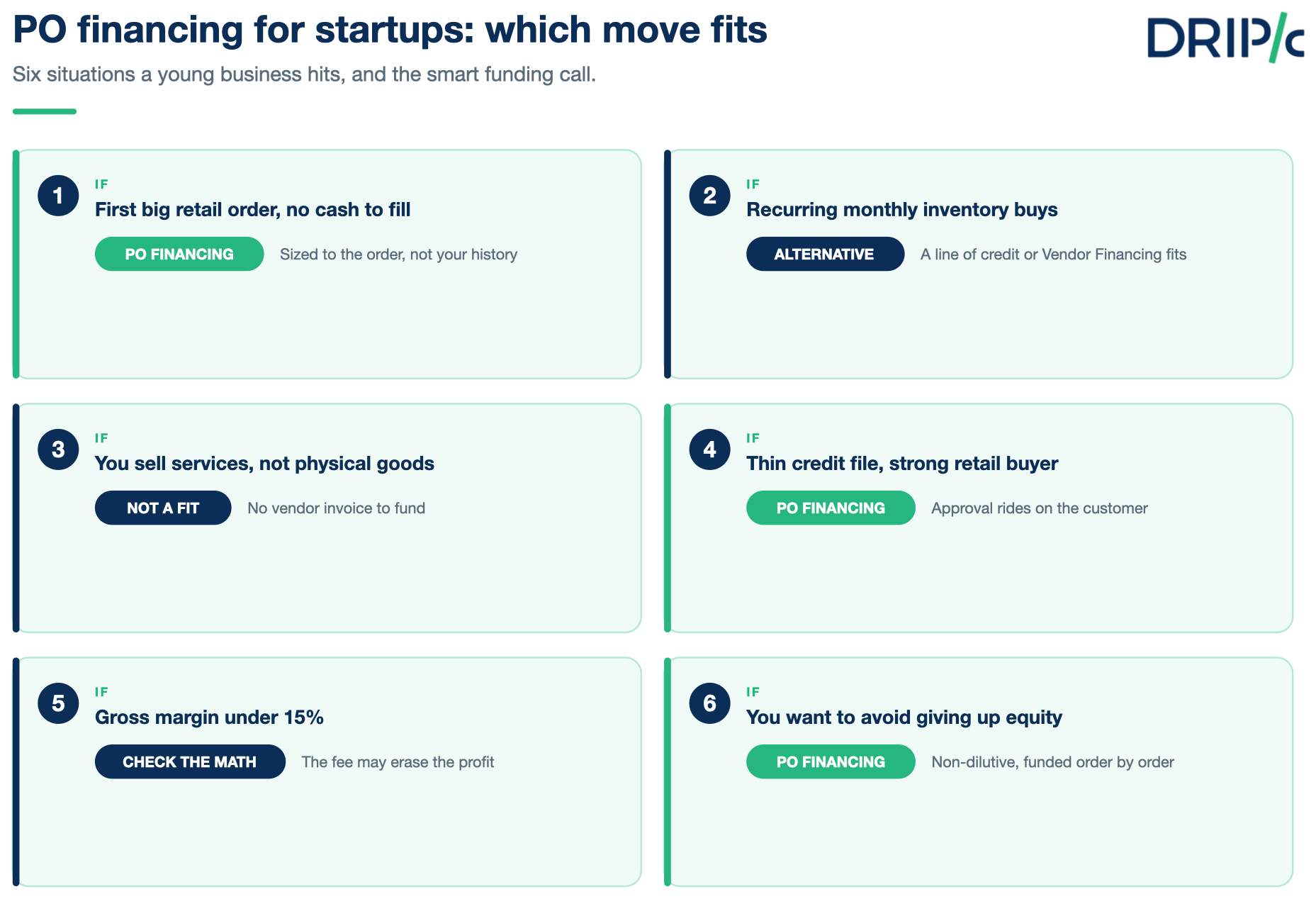
A traditional lender studies your revenue, your years in business, and your credit. A purchase order financier looks first at the creditworthiness of the customer who placed the order and the reliability of the vendor who will fill it. A young business with a thin file but a strong retail buyer can clear that bar.
It scales with the order size
Because the funding is sized to the order, you can accept volume far larger than your cash on hand. The deal that felt impossible becomes one you can actually deliver, without turning the customer away or shipping late.
It protects your equity
Raising a round to fund inventory means giving away ownership to cover a one-time cost. Purchase order financing is not equity; you keep your cap table intact and pay only for the capital you use on that order.
Who Qualifies for Purchase Order Financing
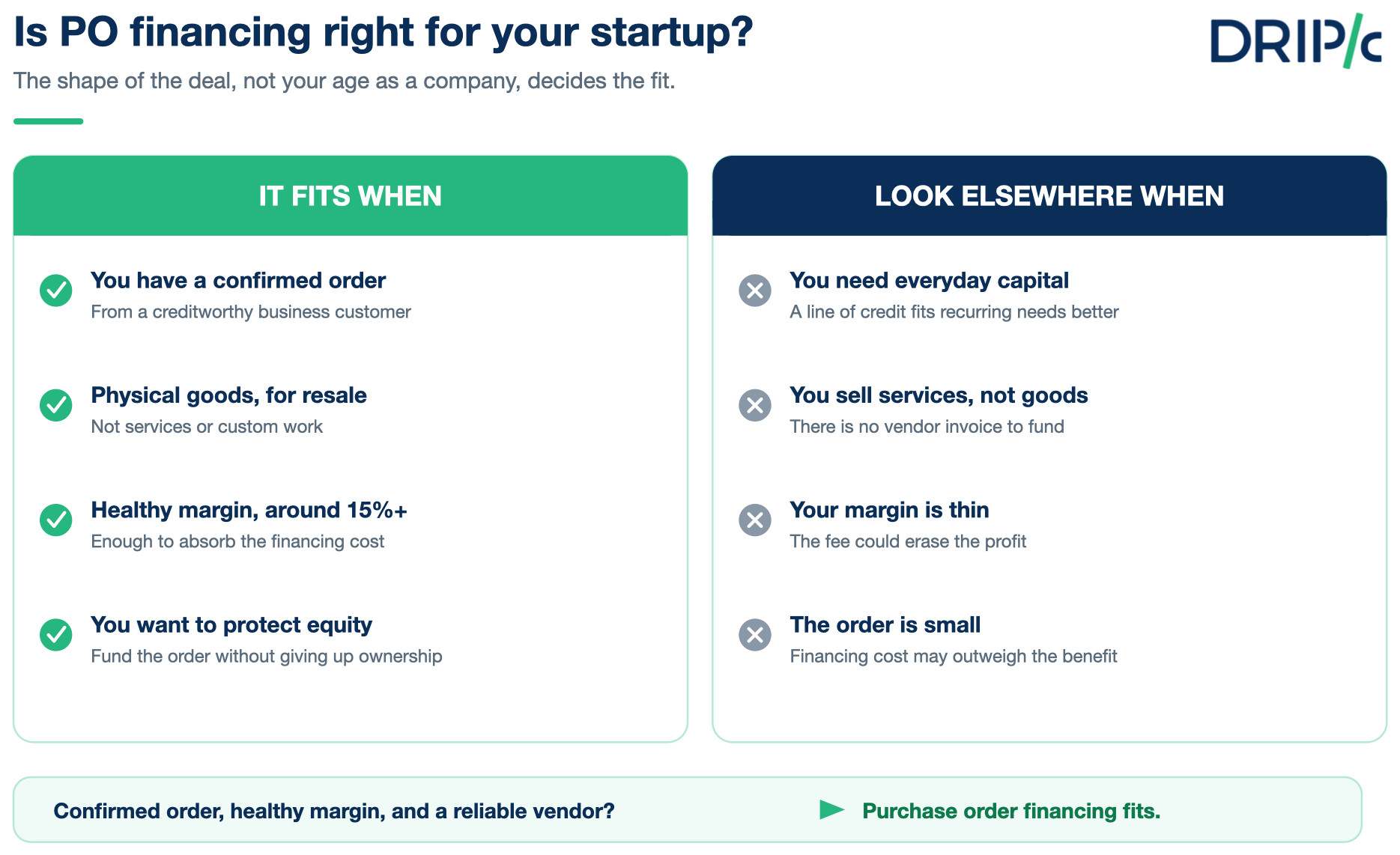
The bar is less about your age as a company and more about the shape of the deal. Financiers generally look for:
- A confirmed business-to-business purchase order from a creditworthy customer.
- Physical goods meant for resale (services and custom work rarely qualify).
- A reliable vendor that can produce and ship on time.
- A healthy gross margin, often around 15% or more, so the financing cost does not erase the profit.
Meet those and a first-year company can qualify where it would be turned down for a bank loan.
What It Costs, and the Tradeoffs
Purchase order financing is not cheap. It is usually priced as a percentage of the order value and costs more than a bank loan, because it is short-term and the financier carries real risk on a single transaction. That price buys access a startup often cannot get any other way, but it eats into margin, which is why the gross-margin test matters.
Two other tradeoffs are worth knowing. The money goes straight to your vendor to pay for producing the order, so it covers fulfillment; plan to fund payroll, rent, and other day-to-day costs from elsewhere. And because each order is financed on its own, it works best for large one-off orders and less well for steady, everyday working capital.

Purchase Order Financing vs Other Startup Funding
Set against the alternatives, the fit gets clearer. Equity funds the order but costs you ownership. A bank loan or line of credit is cheaper, but most startups cannot qualify for one yet. Invoice financing only helps after you have delivered and billed, which is too late to fund production. A working capital loan gives flexibility but leans on your financials.
Purchase order financing sits in the gap the others leave: capital to fill a confirmed order, before you have the history to borrow cheaply. For broader options, our guide to trade finance for startups covers the wider toolkit.
How Drip Capital Helps Startups Fund Orders
Drip Capital gives young importers a way to fund the goods behind an order without a bank line or a funding round. With Vendor Financing, Drip Capital pays your vendor directly when the order ships, so you can fulfill demand far larger than your cash on hand and repay once your own customer pays. The approval leans on the strength of the trade itself, which suits a young company that has not had years to build a credit history. For a startup like Nadia's, that is the difference between shipping the order and losing it.
Frequently Asked Questions
Can a startup with no credit history get purchase order financing?
Often, yes. Approval depends mostly on the creditworthiness of the customer who placed the order and the reliability of your vendor. Your years in business count for far less here than they would with a bank loan.
What are the requirements for purchase order financing?
You generally need a confirmed order from a creditworthy business customer, physical goods for resale, a dependable vendor, and a healthy gross margin. The financing is sized to the order itself.
Is purchase order financing a loan?
Not exactly. It is short-term, transaction-based funding tied to one order, and the financier pays your vendor directly. You repay once your customer settles their invoice.
How much does purchase order financing cost for a startup?
It is priced as a percentage of the order value and costs more than a traditional bank loan, because it is short-term and higher-risk. That is why a solid gross margin matters: the profit on the order needs to comfortably absorb the fee.