

Every business owner discovers this the same way: sometime in October, the calendar starts looking less like a planning tool and more like a bill collector.
The holidays are supposed to be the good part. Sales tick up, foot traffic returns, the year ends on a high note. Nobody warns you that revenue and cash are two different things, and the gap between them widens exactly when everyone else is winding down for the year.
Here's the arithmetic nobody puts on a poster. A retailer that hires seasonal staff to cover November through January is adding headcount weeks before that headcount generates a dollar of margin. A warehouse running overtime to clear a holiday order backlog is paying time-and-a-half on payroll that won't turn into revenue until the order ships, clears customs, and gets paid on term. And somewhere in the middle of all that, a chunk of the workforce is expecting a bonus, because that's the unwritten deal every December: you showed up all year, now show me the number.
None of this is a surprise, exactly. Everyone knows the holidays are coming. What catches businesses off guard is how many other things decide to get complicated at the exact same time.

The part where the world doesn't cooperate
This year, that list is longer than usual. Changes in tariff schedules can make landed costs less predictable when businesses are planning seasonal hiring. A shipping delay that used to cost a few days now sometimes costs a few weeks, because more freight than usual is taking the long way around instead of the fast way through. Add in a labor market where seasonal workers have more options than they used to, and paying competitively isn't optional anymore, it's the price of getting the shift covered at all.
None of these are payroll problems on paper. They're trade problems, logistics problems, labor-market problems. But they all eventually show up in the same place: the account payroll gets paid from. A tariff hike that arrives in October doesn't ask permission before it eats into the margin a business was counting on to cover its December bonus pool. A supply chain hiccup that delays a shipment by three weeks doesn't care that the seasonal staff hired to handle that shipment still need to be paid on the fifteenth and the thirtieth, delay or no delay.
This is the part that's easy to miss if you're only looking at payroll as a payroll problem. It's where every other problem the business has quietly cashes out.
How businesses actually cover the gap
Set aside the version of this where a business just has a large enough cash cushion to shrug the whole thing off. Most don't, and pretending otherwise doesn't help anyone. So here's what businesses actually reach for when the seasonal payroll math doesn't quite line up with the seasonal cash math.
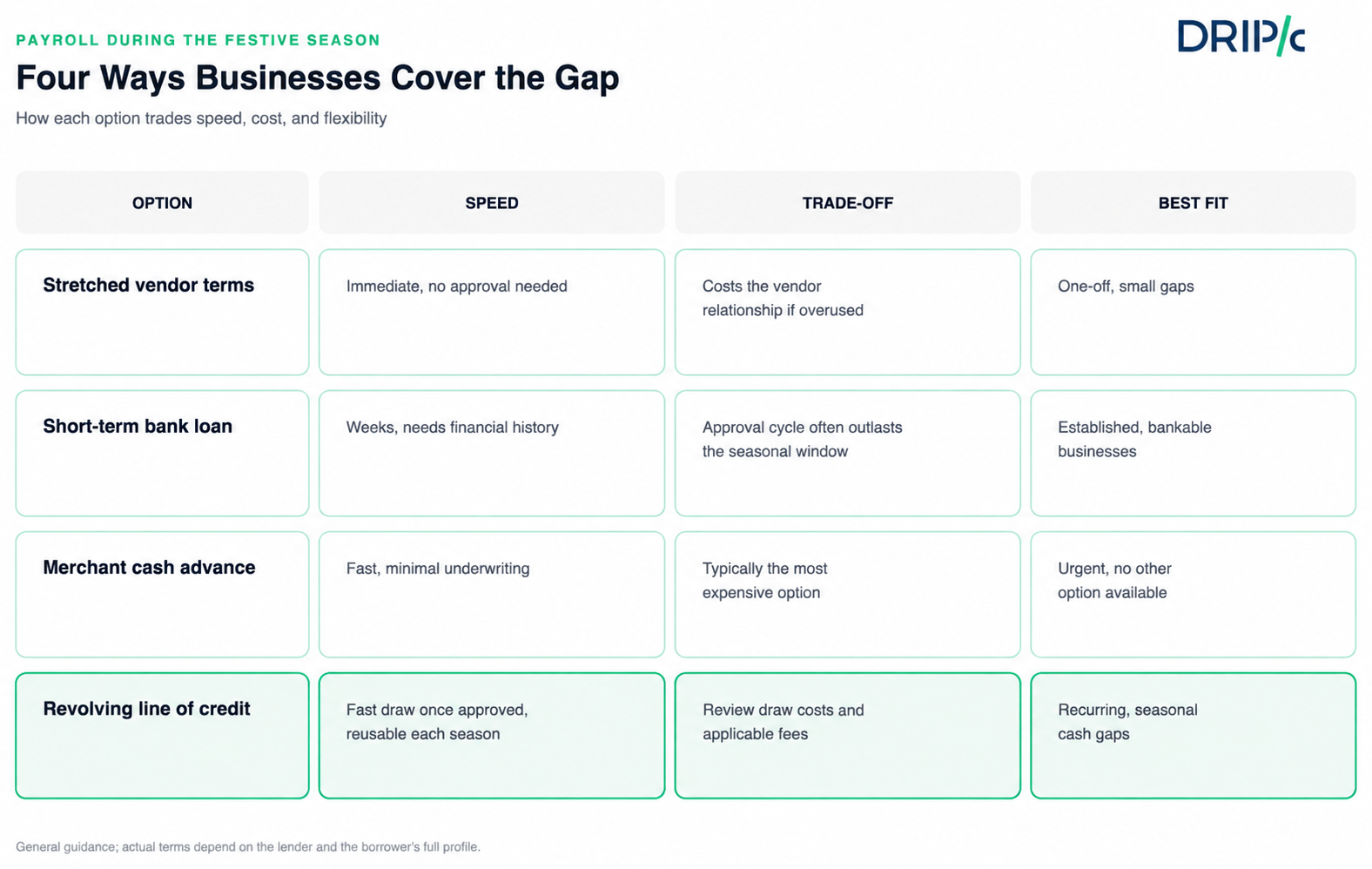
Some lean on trade credit, stretching vendor payment terms a little further than usual and hoping the vendor doesn't notice or mind. It works until the vendor does notice, and then the relationship costs more than the cash flow problem ever did.
Some go to a bank for a short-term loan sized to the season, which works fine if the business has the multi-year financial history a bank wants to see and can stomach a multi-week approval process for what is, fundamentally, a six-week problem.
Some use a merchant cash advance, trading a slice of future card sales for cash today. Fast, yes. Cheap, rarely. The kind of thing you reach for once and then spend the next two quarters trying not to reach for again.
And a growing number lean on a revolving line of credit, precisely because a seasonal payroll crunch is a revolving kind of problem. You don't need the money in July. You need it in November, and again in January when the bonus checks clear, and then you don't need it again until next October. A term loan doesn't know how to be that flexible. A Line of Credit lets a business draw funds as needed, subject to its terms and available credit. Each Drip Capital draw is repaid over six monthly installments; applicable fees should be reviewed before borrowing.
Where a line of credit actually earns its keep
A revolving line of credit is built for exactly this kind of pressure: lumpy, seasonal, and set off by factors outside the business's control. Drip Capital's Line of Credit is built around businesses whose cash timing doesn't move in a straight line, which describes almost any business hiring for the holidays or absorbing a tariff-driven cost spike. The credit decision is fast enough to matter for a need that's fast by nature, and the revolving structure means the facility sits unused for most of the year and gets drawn on exactly when the season demands it.
The actual point
Payroll during the festive season is a pressure test for how well a business's cash flow, its trade exposure, and its labor costs are all talking to each other, at the one time of year when all three decide to move at once. Businesses that treat it as three separate problems tend to get surprised by it every single year. Businesses that treat it as one problem, with one flexible tool sized to absorb the seasonal shape of it, tend to stop being surprised.
The holidays will keep doing what they do: bring in the revenue, bring on the extra hands, and bring around the bonus checks, all in the same six-week window, whether or not the rest of the world cooperates. The only real choice a business has is whether it's prepared for that window before it arrives, or finding that out the hard way, again, every December.