FCL (Full Container Load) and LCL (Less than Container Load) are the two main container shipping options for importers and exporters. The right choice depends on the size of your shipment, your budget, and how quickly you need delivery.
| FCL (Full Container Load) | LCL (Less than Container Load) | |
|---|---|---|
| Definition | You book an entire container exclusively for your cargo | You share a container with other shippers' cargo |
| Best for | Large shipments (typically 15+ CBM) | Small shipments (typically under 15 CBM) |
| Cost basis | Fixed rate per container regardless of cargo volume | Rate per CBM or per ton (whichever is greater) |
| Transit time | Faster - direct port to port | Slower - requires consolidation and deconsolidation |
| Security | Higher - no other cargo in the container | Lower - shared with multiple shippers |
| Cargo damage risk | Lower | Higher - more handling points |
| Documentation | Simpler | More complex - multiple BOLs and consolidation docs |
| Flexibility | Lower - need to fill a full container | Higher - ship any volume |
What is FCL (Full Container Load)?
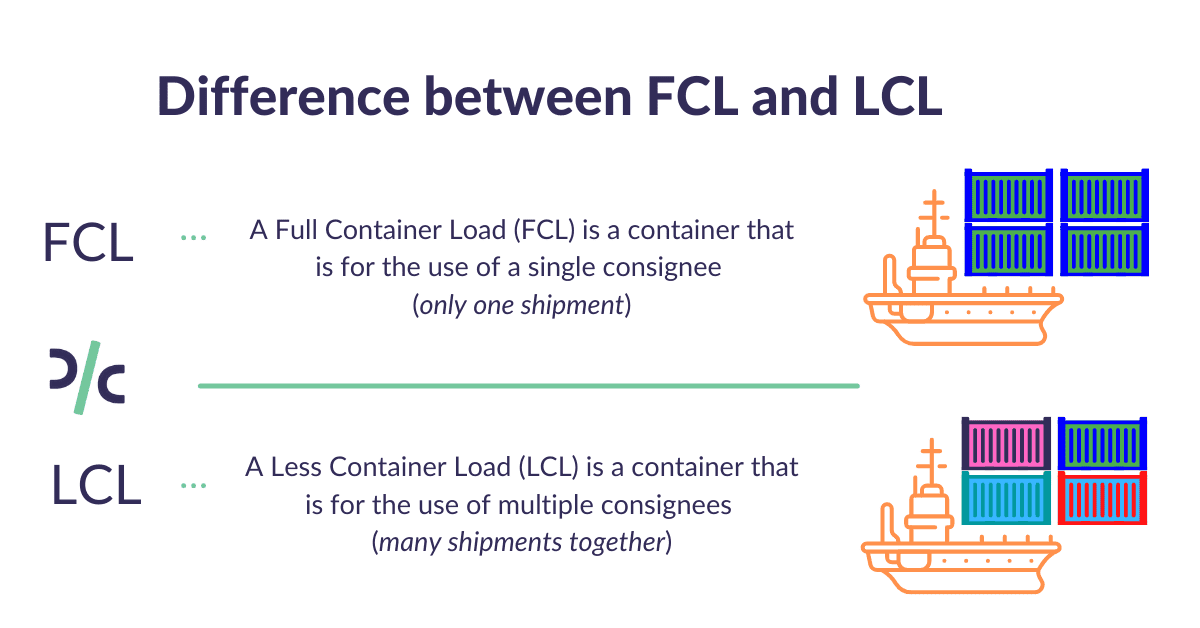
FCL stands for Full Container Load. It means a single shipper books an entire container exclusively for their own cargo. The container is not shared with any other shipper's goods.
FCL is the preferred option when:
- Your shipment volume is large enough to fill or nearly fill a standard 20-foot or 40-foot container
- You are shipping fragile, high-value, or hazardous goods that require dedicated handling
- You need faster transit times with fewer handling points
- You want greater security and reduced risk of damage or contamination
Standard FCL container sizes:
- 20-foot container (20GP): approximately 25-28 CBM usable space, up to 28,000 kg payload
- 40-foot container (40GP): approximately 55-58 CBM usable space, up to 26,500 kg payload
- 40-foot high cube (40HC): approximately 67-68 CBM usable space, extra height for bulky cargo
What is LCL (Less than Container Load)?
LCL stands for Less than Container Load. It means your cargo occupies only part of a container, which is shared with goods from other shippers. A freight forwarder or consolidator combines multiple LCL shipments into one FCL container, then separates them again at the destination.
LCL is the preferred option when:
- Your shipment is too small to justify booking a full container
- You are testing a new market or supplier with a small initial order
- You ship frequently in small volumes and want to avoid waiting to accumulate a full container load
- Cost efficiency matters more than transit time
LCL freight is charged per CBM (cubic meter) or per ton, whichever is greater. Beyond a certain weight threshold, the freight charge switches from volume-based to weight-based.
Also Read: LCL - Less than Container Load: Meaning and Freight Calculation
FCL vs LCL: Key Differences Explained
Cost
FCL has a fixed cost per container regardless of how much space you use. If your cargo fills 80% of a 20-foot container, you pay the same as if it filled 100%. LCL charges by the CBM or ton, so you only pay for the space you use.
The break-even point is typically around 12-15 CBM. Below that threshold, LCL is usually cheaper. Above it, FCL becomes more cost-effective on a per-CBM basis.
Transit Time
FCL is generally faster. The container moves directly from the origin port to the destination port without being opened or repacked along the way. LCL requires consolidation at origin (waiting for other shippers' cargo to fill the container) and deconsolidation at destination (separating your cargo from other shipments), adding days or weeks to transit time.
Security and Damage Risk
FCL offers better security. Your cargo is sealed in its own container and is not handled by anyone until it reaches its destination. LCL involves more handling points - consolidation at origin CFS (Container Freight Station), loading, transit, unloading, and deconsolidation at destination CFS - each of which creates an opportunity for damage or loss.
Documentation
FCL documentation is straightforward - one Bill of Lading for your shipment. LCL documentation is more complex - the freight forwarder issues a House Bill of Lading (HBL) to you and a Master Bill of Lading (MBL) for the consolidated container, adding a layer of documentation and coordination.
Documents Required for FCL and LCL Shipments
Both FCL and LCL shipments require the following core documents:
- Bill of Lading or Ocean Bill of Lading
- Certificate of Origin
- Commercial Invoice
- Packing List
- Fumigation Certificate (if required by destination country)
- Inspection Certificate
- Marine Insurance
For LCL shipments, the freight forwarder also issues a House Bill of Lading (HBL) in addition to the Master Bill of Lading. Documentation requirements vary by commodity and country of origin.
FCL vs LCL: Cost Comparison
| Cost Factor | FCL | LCL |
|---|---|---|
| Base freight | Fixed per container (20ft or 40ft) | Per CBM or per ton |
| Terminal handling charges (THC) | Included in container rate | Charged separately per CBM |
| Documentation fees | Lower | Higher (HBL + consolidation fees) |
| CFS charges | Not applicable | Charged at origin and destination CFS |
| Break-even point | Typically 12-15 CBM - above this FCL is usually cheaper per CBM | |
When to Choose FCL vs LCL
Choose FCL when:
- Your shipment volume exceeds 15 CBM
- You are shipping fragile, high-value, or temperature-sensitive goods
- You need the fastest possible transit time
- You want to minimise cargo handling and damage risk
- You are shipping hazardous materials that cannot be consolidated
Choose LCL when:
- Your shipment is under 12-15 CBM
- You are making a small test order or a sample shipment
- You ship regularly in small volumes
- Cost is the primary concern and transit time is flexible
- You want to ship without waiting to accumulate a full container load
Also Read: Export Logistics and its Process
Frequently Asked Questions
What is the difference between FCL and LCL?
FCL (Full Container Load) means you book an entire container exclusively for your cargo. LCL (Less than Container Load) means your cargo shares a container with other shippers' goods. FCL is faster, more secure, and cheaper per CBM for large shipments. LCL is more cost-effective for small shipments where you only pay for the space you use.
When should I use FCL over LCL?
Use FCL when your shipment exceeds 12-15 CBM, when you are shipping fragile or high-value goods, when you need faster transit times, or when you want to reduce cargo handling and damage risk. Use LCL for smaller shipments, test orders, or when cost efficiency matters more than speed.
Is LCL cheaper than FCL?
LCL is cheaper in total cost for small shipments because you only pay for the space you use. However, for shipments above 12-15 CBM, FCL becomes cheaper on a per-CBM basis. LCL also carries additional charges such as CFS handling fees and documentation charges that do not apply to FCL.
How is LCL freight calculated?
LCL freight is calculated per CBM (cubic meter) or per ton, whichever is greater. To calculate CBM, multiply the length x width x height of each package in meters. The total volume or weight is then multiplied by the freight rate per CBM or per ton quoted by the carrier or freight forwarder.
What is a CFS in LCL shipping?
CFS stands for Container Freight Station. It is a warehouse facility where LCL cargo is consolidated (at origin) before loading onto a ship, and deconsolidated (at destination) after the container is unloaded. CFS charges are applied at both origin and destination and are an additional cost of LCL shipping that does not apply to FCL.
How much longer does LCL take compared to FCL?
LCL typically takes 3-7 days longer than FCL on the same route due to the time required for consolidation at origin and deconsolidation at destination. For time-sensitive shipments, FCL is generally the better choice.
What documents are needed for LCL shipments?
LCL shipments require a Commercial Invoice, Packing List, Certificate of Origin, and a House Bill of Lading (HBL) issued by the freight forwarder. The freight forwarder holds the Master Bill of Lading (MBL) for the consolidated container. Additional documents such as fumigation certificates or inspection reports may be required depending on the commodity and destination country.