
Bill of Lading vs Air Waybill: Key Differences and When You Need Each
Every international shipment travels with paperwork, and two documents sit at the center of it: the bill of lading and the air waybill (also written as airway bill). They look similar on the surface. Both prove a carrier received your goods, and both set out the terms of carriage. The difference that matters most is what each one lets you do with the goods while they are still moving.
In 2023, US international trade in goods reached $5.1 trillion, with waterborne vessels the leading transportation mode by value. Most of that cargo moved under a bill of lading. Air freight is faster and carries a smaller share, and it moves under an air waybill. Knowing which document you hold, and why it is built the way it is, saves you from expensive mistakes at the port or the airport.
This guide breaks down what each document is, how they differ, and when you need one over the other.
What Is a Bill of Lading?
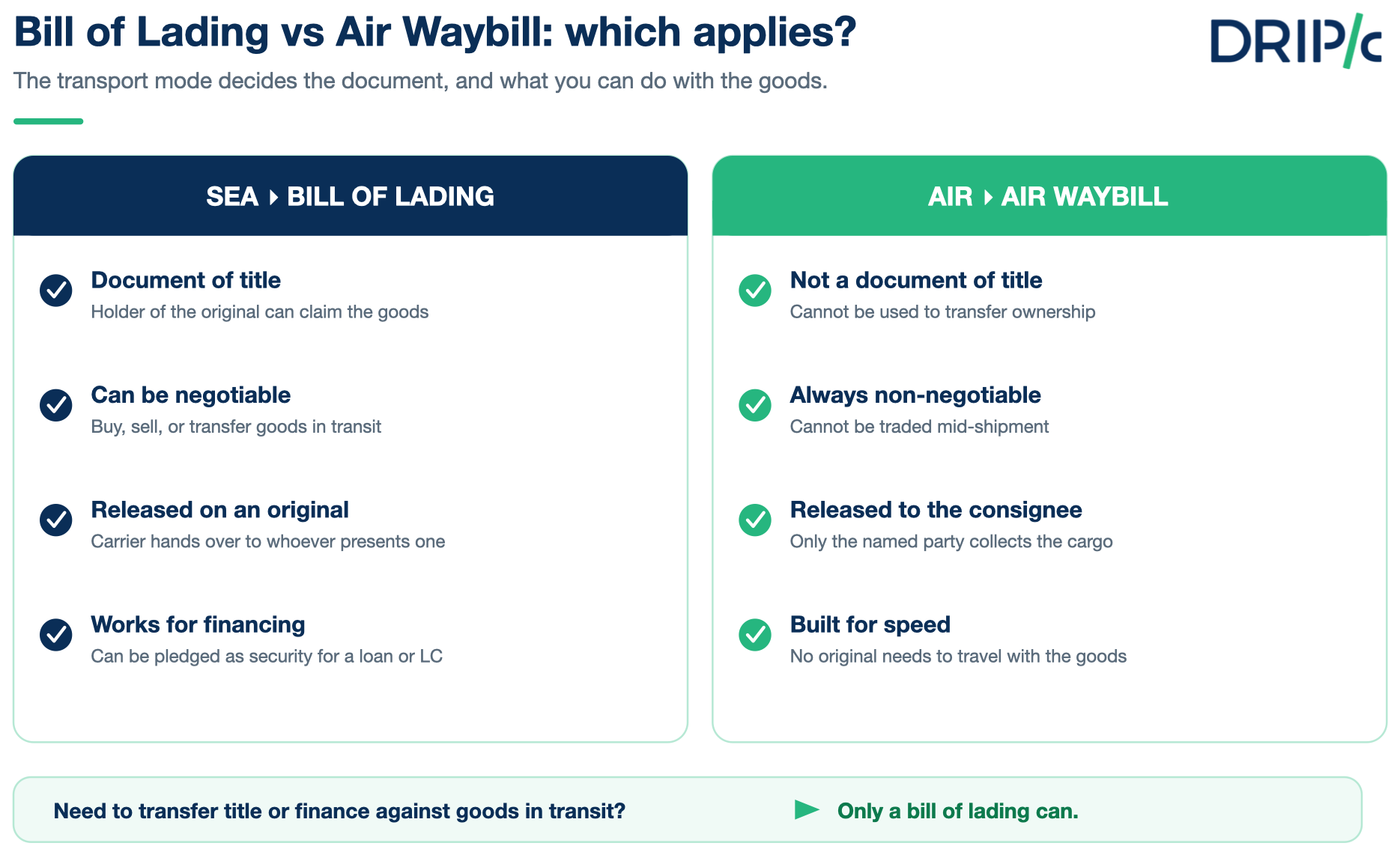
A bill of lading is the document an ocean carrier issues when it takes your goods for sea transport. It does three jobs at once: it is a receipt for the cargo, a contract of carriage, and a document of title. That third role is the one that sets it apart. A document of title means whoever holds the original bill of lading holds the right to claim the goods.
Because of that, a bill of lading can be negotiable. It can be bought, sold, or transferred while the goods are still at sea, which is what makes it so useful in trade finance. For the full mechanics and the different types, see our bill of lading guide.
What Is an Air Waybill?
An air waybill is the equivalent document for air cargo, issued by the airline or its agent when the shipment is accepted. Like a bill of lading, it works as a receipt and a contract of carriage. What it lacks is title: an air waybill does not give the holder ownership of the goods.
An air waybill is non-negotiable. It names a specific consignee, and only that named party can receive the goods on arrival. You cannot trade it or use it to transfer ownership mid-flight. Our air waybill guide walks through its format, copies, and tracking number.
Bill of Lading vs Air Waybill: The Key Differences
The two documents diverge on a handful of points that decide how your shipment, and any financing tied to it, actually works.
| Feature | Bill of Lading | Air Waybill |
|---|---|---|
| Mode of transport | Sea freight | Air freight |
| Issued by | Shipping line (ocean carrier) | Airline or its agent |
| Document of title | Yes | No |
| Negotiable | Can be negotiable | Always non-negotiable |
| Goods released to | Whoever presents an original (if negotiable) | Named consignee only |
| Number of originals | Usually a set of three | Non-negotiable set; no original required for release |
| Speed of release | Slower; an original often must be presented | Faster; built for quick release |
| Usable as loan collateral | Yes, when negotiable | No |
Negotiability and title
This is the heart of it. A bill of lading can be a document of title and can be negotiable; an air waybill is always non-negotiable and never transfers title. If you need to sell goods in transit or pledge them as security, only a bill of lading gives you that option.
Who issues it, and how goods are released
A shipping line issues the bill of lading; an airline or its agent issues the air waybill. With a negotiable bill of lading, the carrier releases the goods to whoever presents an original. With an air waybill, the carrier releases the goods to the named consignee against proof of identity, with no original document required.
Speed and number of originals
A bill of lading is usually issued as a set of three originals that travel separately for security. An air waybill is issued as a non-negotiable set. Because air shipments move fast, the document is built above all for speed of release.
Why the Difference Matters for Financing
Here is where the distinction stops being academic. Because a bill of lading is a document of title, a bank or lender can hold it as security: control the document, control the goods. That is why bills of lading sit at the heart of Letters of Credit and documentary collections.
An air waybill cannot play that role. It does not confer title, so it cannot be pledged the same way. Financing an air shipment leans on other parts of the trade, such as the invoice and the buyer relationship; the transport document itself carries no title to pledge. If you finance your imports, the document type quietly shapes what is possible.

When to Use Each
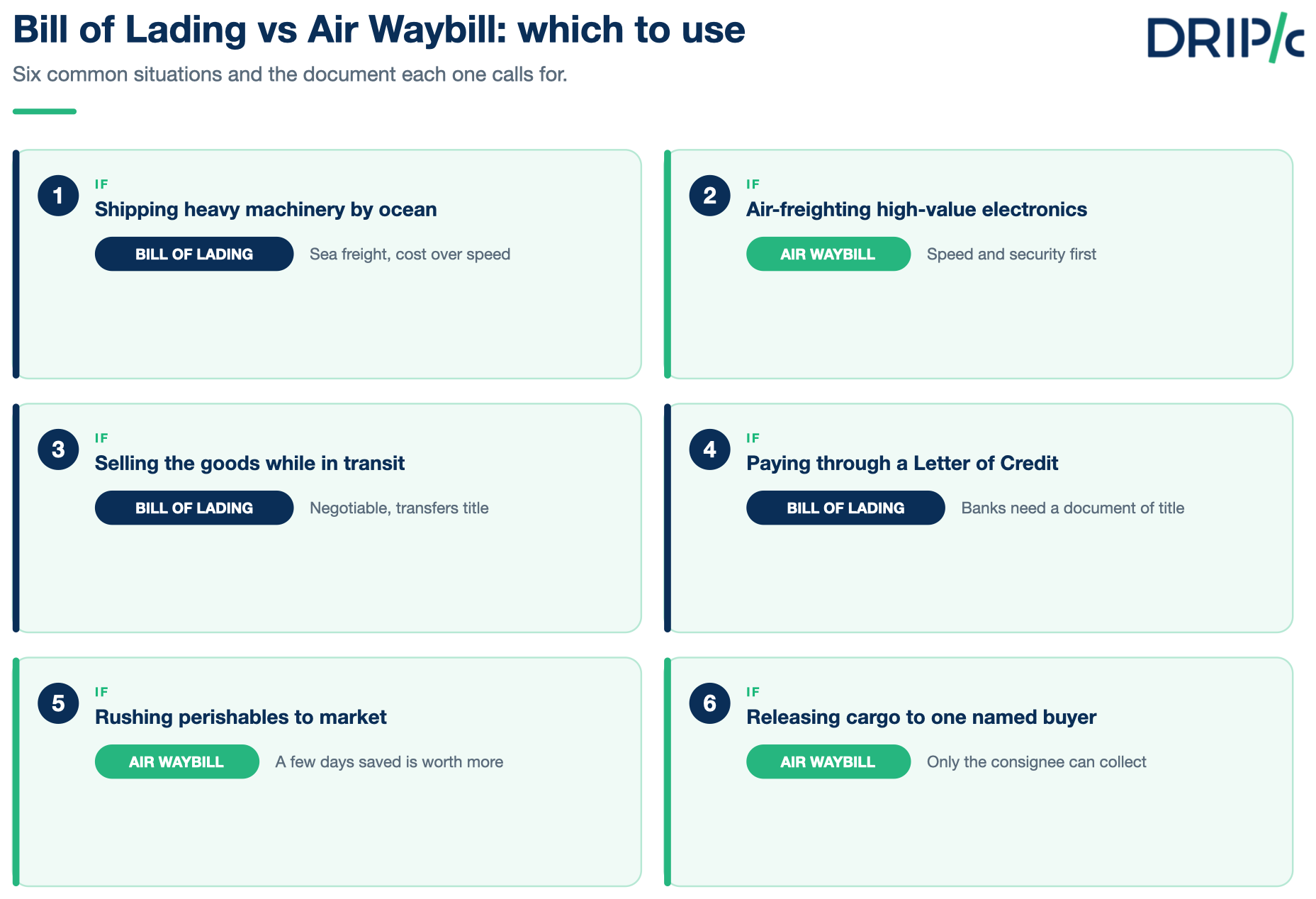
You rarely pick the document on its own. You pick the mode of transport, and the document follows. Ship by sea and you get a bill of lading. Ship by air and you get an air waybill.
Choose sea freight and a bill of lading when cargo is large or heavy, when cost matters more than speed, or when you need to transfer title or finance against the goods in transit. Choose air freight and an air waybill when speed is the priority: high-value goods, perishables, or urgent restocks where a few days saved outweigh the higher cost.
How Drip Capital Works With These Documents
Drip Capital finances the goods these documents represent. With Vendor Financing, Drip Capital pays your vendor directly when an order ships, whether it moves under a bill of lading or an air waybill, so you can take delivery without tying up your own cash. The shipping document tells the story of the cargo; Drip Capital makes sure the money keeps pace with it.
Frequently Asked Questions
Is an air waybill a type of bill of lading?
Loosely, yes. Both are transport documents that act as a receipt and a contract of carriage. The key difference is that a bill of lading can be a negotiable document of title, while an air waybill is always non-negotiable.
Is an air waybill negotiable?
No. An air waybill is always non-negotiable and does not transfer ownership of the goods. It names a single consignee, and only that party can collect the shipment on arrival.
Can a shipment have both a bill of lading and an air waybill?
Not for the same leg. A single movement goes by either sea or air and carries the matching document. A multimodal journey can involve different documents across legs, but one leg has one transport document.
Which document is faster to process?
An air waybill. It is non-negotiable and does not need an original to travel with the goods, so release at the destination is quicker. A bill of lading involves more handling because an original often has to be presented.